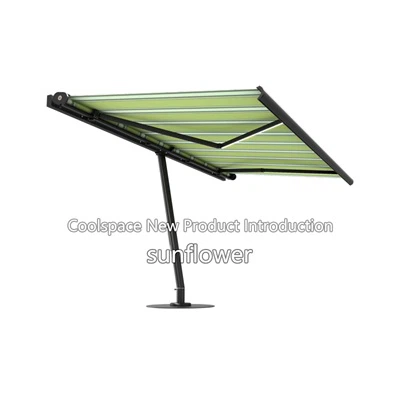

The performance advantages of retractable awnings stem from their systematic optimization in structural mechanics, materials science, and functional integration, enabling them to maintain stable and efficient operation in diverse outdoor environments. Their comprehensive performance is mainly reflected in load-bearing capacity, sun shading and heat insulation, weather resistance and wind resistance, operational reliability, and aesthetic durability, providing solid protection for various application scenarios.
Firstly, there is load-bearing capacity and structural stability. Retractable awnings use high-strength aluminum alloy or galvanized steel to construct the support frame, possessing both lightweight and high-strength characteristics. This ensures overall lightness while withstanding significant wind pressure and self-weight loads. The articulated arm mechanism, through multi-node articulation and mechanical optimization, creates a uniformly stressed system when the awning is extended, effectively distributing external loads, preventing local deformation or instability, and ensuring long-term safe and reliable use.
Secondly, there is sun shading and heat insulation performance. The awning fabric is often made of UV-resistant, high-colorfastness polyester fiber or PVC-coated fabric, which can block most direct sunlight and significantly reduce radiant heat entering the shaded area, improving human comfort. Some high-performance awning fabrics also have moderate breathability, reducing stuffiness and maintaining a more pleasant microclimate in hot seasons.
Thirdly, there is weather resistance and wind resistance. High-quality awning fabrics are treated with waterproofing, mildew resistance, and anti-aging treatments to withstand complex weather conditions such as sun exposure, rain, and temperature changes; the frame and connectors are often treated with anodizing, powder coating, or hot-dip galvanizing processes to enhance corrosion resistance. For high-wind areas, wind-resistant reinforcement components and cable systems can be configured to improve the overall wind resistance level and ensure structural integrity in harsh weather conditions.
Operational reliability is also a key performance indicator. Manual types rely on precision gears or crank drives, with a simple structure and low failure rate; electric types integrate silent motors and limit protection, ensuring smooth operation and precise positioning. Intelligent control versions can also be connected to wind and rain sensors and timing modules to achieve automatic opening and closing, improving management convenience and safety.
Finally, there is aesthetics and durability. The curved arm design features smooth lines, harmonizing seamlessly with the building facade or landscape; the awning fabric's color and texture are customizable, balancing decorative effect with lightfastness to ensure a good appearance even after long-term use.
In summary, the curved arm awning, with its excellent load-bearing stability, sun shading and heat insulation properties, weather and wind resistance, reliable operation, and lasting aesthetic appeal, constitutes a high-performance solution in the field of outdoor shading, meeting the dual requirements of quality and safety for residential, commercial, and public spaces.
 English
- English
- Français
- Deutsch
- 日本語
- Italiano
- Español
- Português
- русский
- Nederlands
- Melayu
- українська
- Norsk
- suomi
- Ελληνικά
- magyar
- ไทย
- bosanski
- Polski
- Latviešu
- Malti
- slovenčina
- Български
- עברית
- Việt Nam
- Svenska
- Čeština
- فارسی
- Lietuvių
- Indonesia
- Eesti
- اردو
- hrvatski
- Gaeilgenah Éireann
- O'zbek
- Català
- Türkçe
- 한국어
- Bai Miaowen
- dansk
- हिंदी
- Srbija jezik (latinica)
- বাংলা
- عربي
- Cymraeg
- slovenščina
- România limbi
- Kreyòl Ayisyen
- íslenska