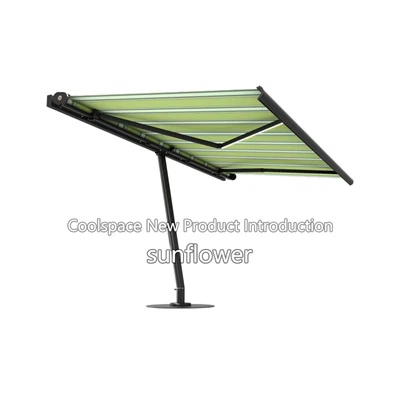

Against the backdrop of continuously improving urban living environments and increasing demands for building energy efficiency, window awnings have evolved from simple shading tools into comprehensive solutions integrating environmental control, aesthetic presentation, and intelligent management. A complete window awning solution requires systematic design focusing on climate adaptability, functional compatibility, structural reliability, and ease of use, to achieve precise control and long-term service for the indoor light and thermal environment.
The development of a solution begins with a comprehensive assessment of the application environment. Different regions have significant differences in solar radiation intensity, precipitation characteristics, wind speed, and air quality, which determine the differentiated requirements for awning material weather resistance, wind load resistance, and drainage and waterproofing performance. For example, humid and rainy areas require priority consideration of mildew and antibacterial properties and efficient drainage structures, while cold and snowy regions should strengthen anti-freezing and snow accumulation prevention designs; exterior windows of high-rise buildings face greater wind pressure, requiring higher standards for frame rigidity and fixing methods. By combining meteorological data and on-site surveys, scientific boundary conditions can be provided for the solution.
Functional compatibility is a core aspect of solution design. Window awnings should not only meet basic shading and heat insulation needs but also consider multiple objectives such as glare reduction, privacy protection, view adjustment, and compatibility with architectural style. For windows facing different directions, fixed, adjustable-angle, or intelligent tracking awnings can be configured to achieve dynamic optimization of the shading curve throughout the year; in commercial and public buildings, light and temperature-sensitive control can be introduced to ensure that shading actions are synchronized with changes in the indoor and outdoor environment, thereby significantly reducing air conditioning and lighting energy consumption. Material selection should also correspond to the target function; high-reflectivity coated fabrics are suitable for high heat gain control, while translucent membrane materials are conducive to maintaining a bright indoor atmosphere.
Structural reliability is ensured by mature components and manufacturing processes. The solution should include a support system design that adapts to the building facade, ensuring that the connection between the base and the wall meets local building codes and safety factors; the drive system should use manual or electric modes based on usage frequency and span, and pre-set safety mechanisms such as wind protection, anti-pinch, and emergency braking. The awning fabrication process must ensure dimensional accuracy and joint strength to prevent premature aging or operational malfunctions caused by manufacturing defects. The overall solution should also clearly define the installation procedures, acceptance criteria, and maintenance cycles to create a closed-loop management system throughout the product's lifecycle.
Ease of use and intelligence are important extensions of modern solutions. By integrating programmable controllers, wireless communication modules, and mobile terminal applications, users can remotely set shading strategies, view operating status, and receive anomaly alerts. Some solutions can also be integrated with building energy management systems to achieve coordinated optimization of shading, HVAC, and lighting, further improving overall energy efficiency.
In summary, window awning solutions are not merely a collection of individual products, but rather a systems engineering approach based on multi-dimensional considerations of environment, function, structure, and intelligence. It is based on scientific analysis, implemented through precise design, and supported by reliable execution and continuous service, creating a more comfortable indoor environment for buildings and demonstrating tangible value in energy conservation, emission reduction, and sustainable construction.
 English
- English
- Français
- Deutsch
- 日本語
- Italiano
- Español
- Português
- русский
- Nederlands
- Melayu
- українська
- Norsk
- suomi
- Ελληνικά
- magyar
- ไทย
- bosanski
- Polski
- Latviešu
- Malti
- slovenčina
- Български
- עברית
- Việt Nam
- Svenska
- Čeština
- فارسی
- Lietuvių
- Indonesia
- Eesti
- اردو
- hrvatski
- Gaeilgenah Éireann
- O'zbek
- Català
- Türkçe
- 한국어
- Bai Miaowen
- dansk
- हिंदी
- Srbija jezik (latinica)
- বাংলা
- عربي
- Cymraeg
- slovenščina
- România limbi
- Kreyòl Ayisyen
- íslenska